
Next project
Ahad Brothers billing & inventory
ZNova project · Web app · Delivered
Billing, stock and staff attendance for Ahad Brothers' two uniform branches, each kept apart behind two-step sign-in, in one React and NestJS application.
ZNova projectWebsite · 2026
An SEO-first studio site with 33 service pages, three switchable themes and a headless blog, held to a performance budget on every commit.
Built byAhsan NadeemZNova is a new software, AI and IT studio, and its website has three jobs at once: rank in search, load fast on any phone, and explain eight service lines in enough depth that a visitor can judge whether we're the right team.
It also had to grow without slowing down. The team needed to publish insights without waiting on a developer, add service pages without a redesign, and keep every page fast instead of getting a little heavier with each release.
We built it as one TypeScript monorepo: SolidStart for the website and Payload CMS on PostgreSQL for the insights blog. Every page outside the blog is typed content rendered through a registry of lazy sections, so each page gets its own composition and only downloads the sections it actually shows.
Static pages are prerendered at build time, while insights and search are rendered on the server, so pages arrive as complete HTML and only the interactive parts hydrate. One token-based design system drives three switchable themes, and every component is built to WCAG 2.2 AA, with visible focus, verified colour contrast and reduced-motion support.
SEO is part of the build, not a plugin: metadata, JSON-LD structured data, sitemaps, RSS and llms.txt are generated from the same content as the pages.
The site covers 33 service and sub-service pages, team profiles, projects, FAQs, free tools and a CMS-backed insights hub, all from one codebase.
Lint, type, unit, accessibility and performance checks run on every commit through Azure DevOps, and no route may ship more than 70 KB of JavaScript, so speed is held by the pipeline, not hoped for. The site is served from Cloudflare's edge.
A look at the screens. Drag the front one aside or use the arrows to flip through.
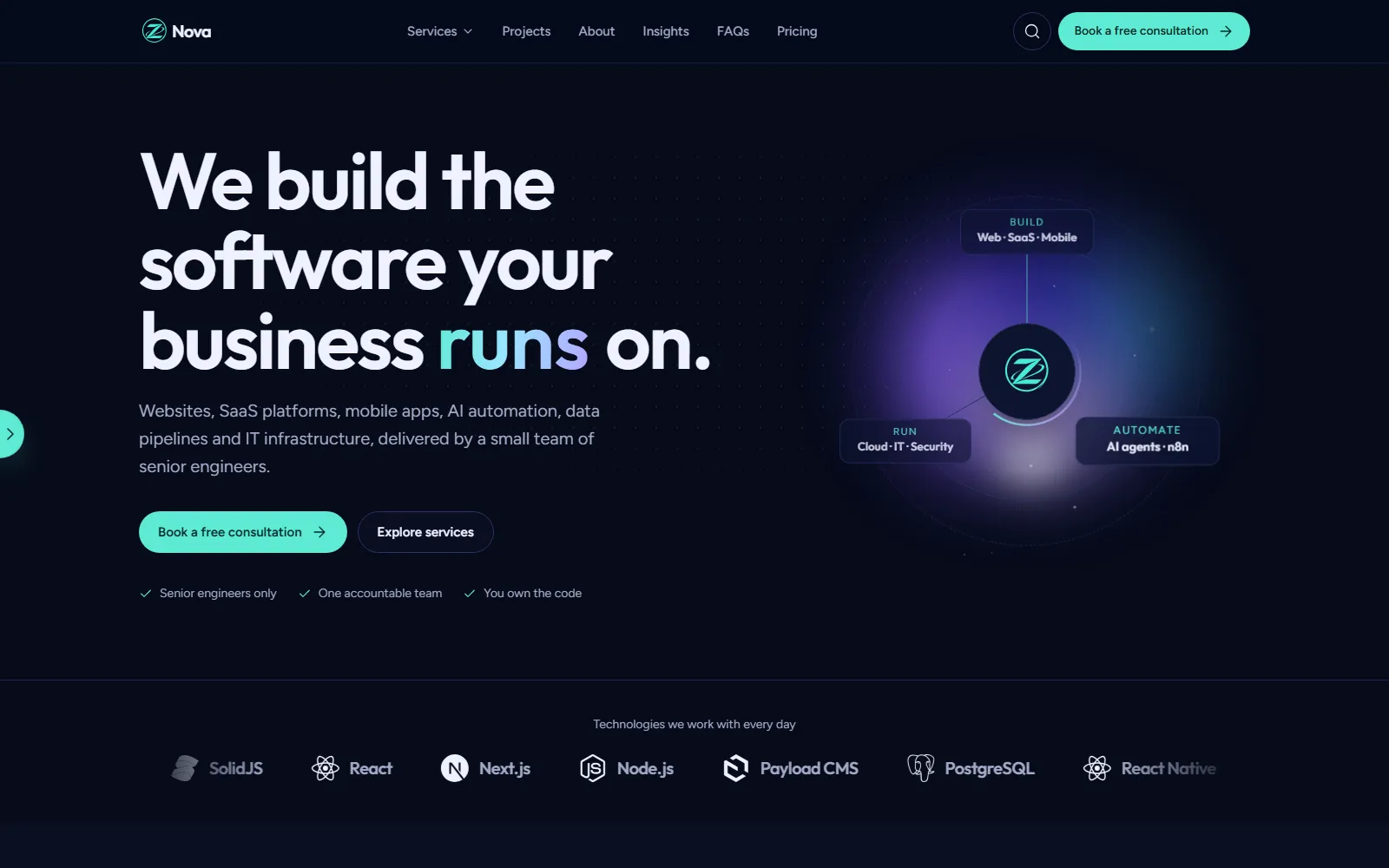
Home page (1 / 4)
From what people see down to what it runs on, with the stack behind each layer.
The capabilities that went live, one card each.
Every service and sub-service has its own URL, copy and section mix, built from one shared set of sections.
Colour, type and surfaces come from design tokens, so the whole site re-themes without touching a component.
Articles, categories and authors live in Payload CMS, so the team publishes without a developer.
Metadata, JSON-LD, sitemaps, RSS and llms.txt are generated from the same content as the pages.
JavaScript and CSS budgets run on every commit, so a page can't quietly get heavier.
Semantic HTML, visible focus, verified contrast pairs and reduced-motion support on every component.
The engineering calls behind the build, and why they were made.
Marketing copy lives in typed TypeScript objects and only the blog uses the CMS. A broken page is a build error, not a surprise in production, and static pages need no database at all.
Pages are ordered lists of sections, each loaded on demand. Thirty-three pages share the same parts, yet a page only downloads what it shows.
Pages arrive fully rendered and only the interactive parts hydrate, which keeps the first paint fast on mid-range phones.
Every route is measured after each build. Going over 70 KB of JavaScript fails the pipeline, so speed is held, not hoped for.
Next project
ZNova project · Web app · Delivered
Billing, stock and staff attendance for Ahad Brothers' two uniform branches, each kept apart behind two-step sign-in, in one React and NestJS application.
That's the kind we like. Tell us about it and we'll reply with how we'd approach it.
Change theme