
Next project
Ahad Brothers online store
ZNova project · E-commerce · 2026
A WooCommerce store for a school-uniform maker: parents find their school, build its exact kit by season, class and age, and check out in one basket.
ZNova projectWebsite · 2026
A non-commercial site that explains six humanitarian crises in two-minute, UN-sourced briefings and links straight to verified charities. Built pro bono.
Built byAhsan NadeemWhen a crisis is in the news, it is hard to know what is true, what people actually need, and which appeals can be trusted. Nidaa (نداء, “a call”) answers those three questions in a couple of minutes for Gaza, Sudan, DR Congo, Yemen, the Rohingya and Afghanistan.
It had to earn trust: every figure needed a named source and date, the site could never touch donations, and it had to stay free of ads, cookies and trackers while still thanking the people who give.
We built Nidaa as a static Astro site. Crisis briefings, charities and Insights articles are typed content, and the build fails if a figure loses its source or an article names an unknown crisis or cover photo.
Every donate button opens the charity’s own page. Visitors can then tell Nidaa they gave: a small Cloudflare Pages Functions API validates the form on the server, stores it in D1 and sends a thank-you email through Brevo. Forms post normally without JavaScript, and the script on the page is progressive enhancement only.
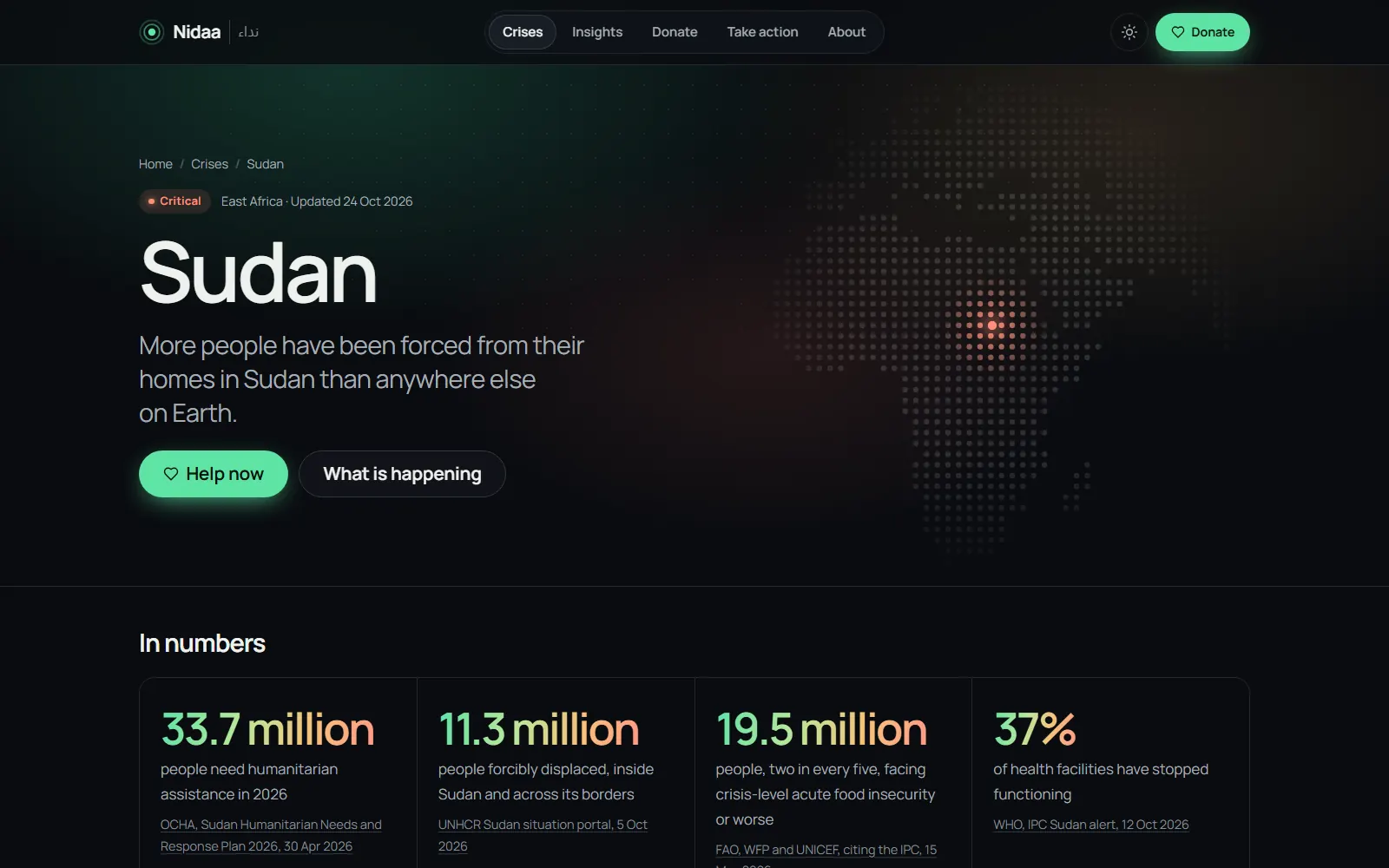
The design is dark-first, with soft aurora light and a dotted world map that marks each crisis by severity. Each briefing zooms the map to its crisis, so the site needs almost no imagery.
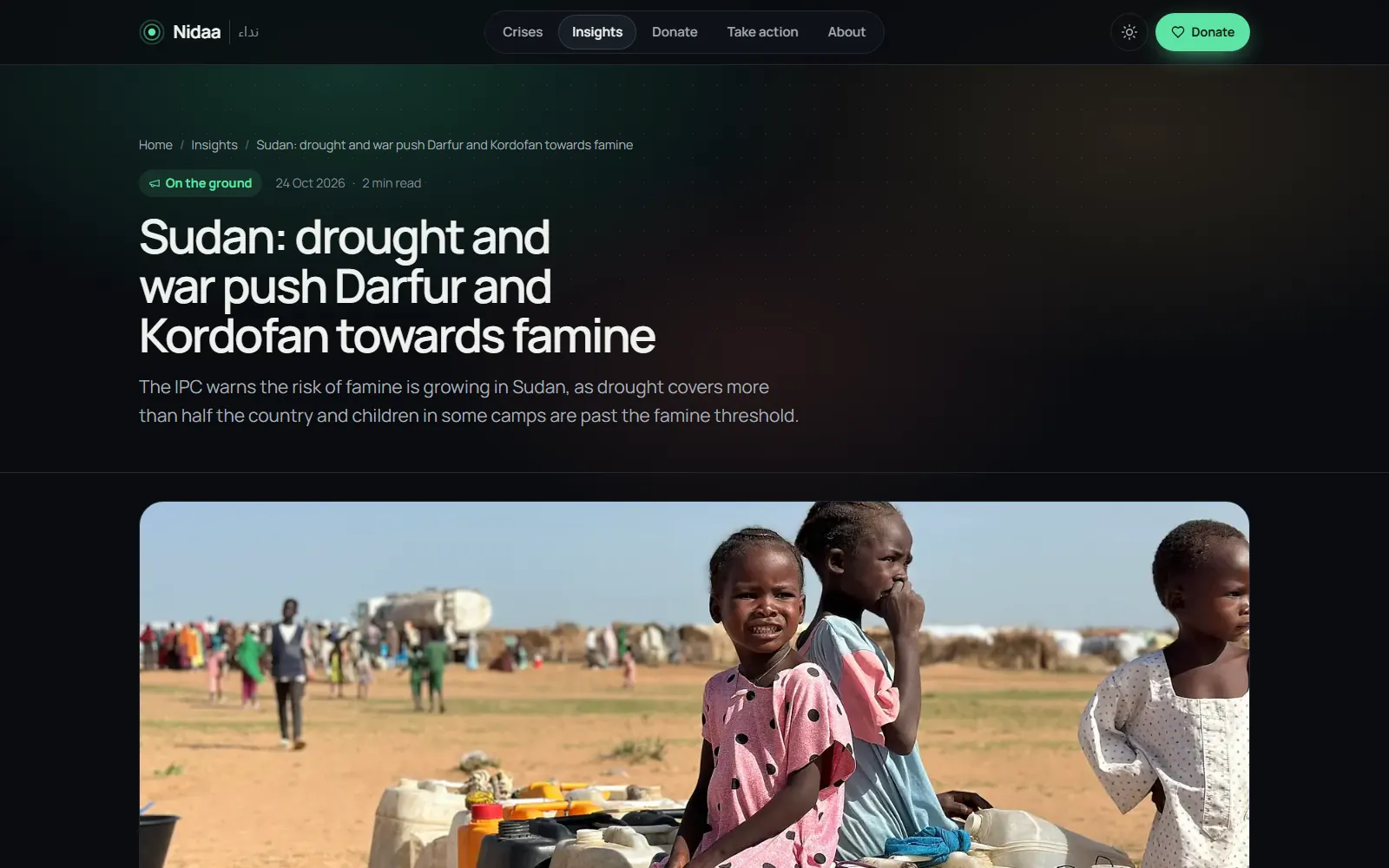
Six crisis briefings, Insights articles with credited, openly licensed cover photos, and verified charities for each crisis, with every figure checked against the UN (OCHA, UNHCR, UNICEF, WFP, WHO) or the IPC.
Every page is tested at three screen widths and in both themes, for accessibility (WCAG 2.2 AA), console and CSP errors and broken links, with an end-to-end test of the thank-you form. Built and maintained pro bono by ZNova.
A look at the screens. Drag the front one aside or use the arrows to flip through.
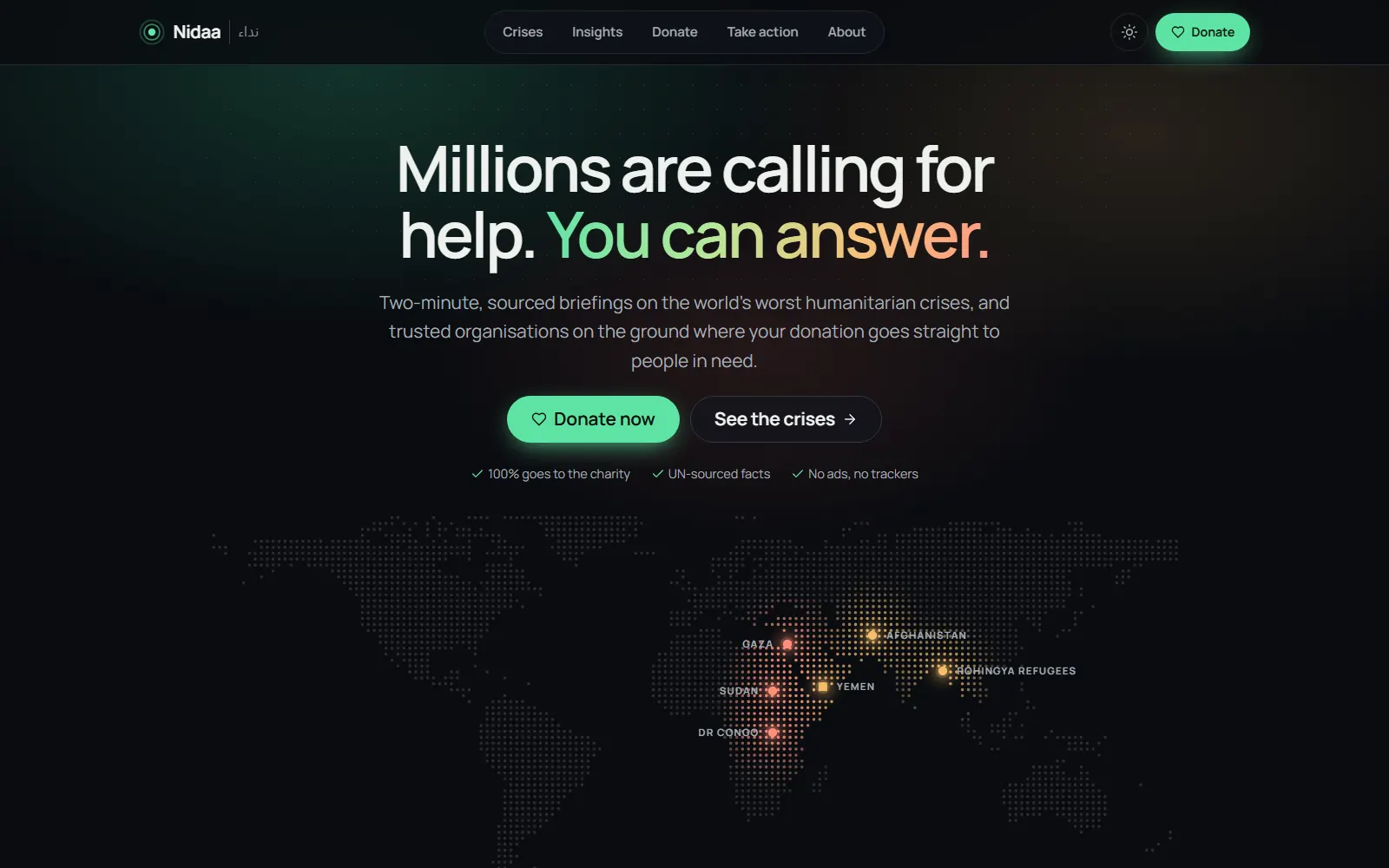
Home page (1 / 4)
From what people see down to what it runs on, with the stack behind each layer.
The capabilities that went live, one card each.
Each crisis glows on a dotted world map by severity, with its latest sourced figure on hover or focus.
Numbers come from the UN or the IPC with a date, and the build fails if one loses its source.
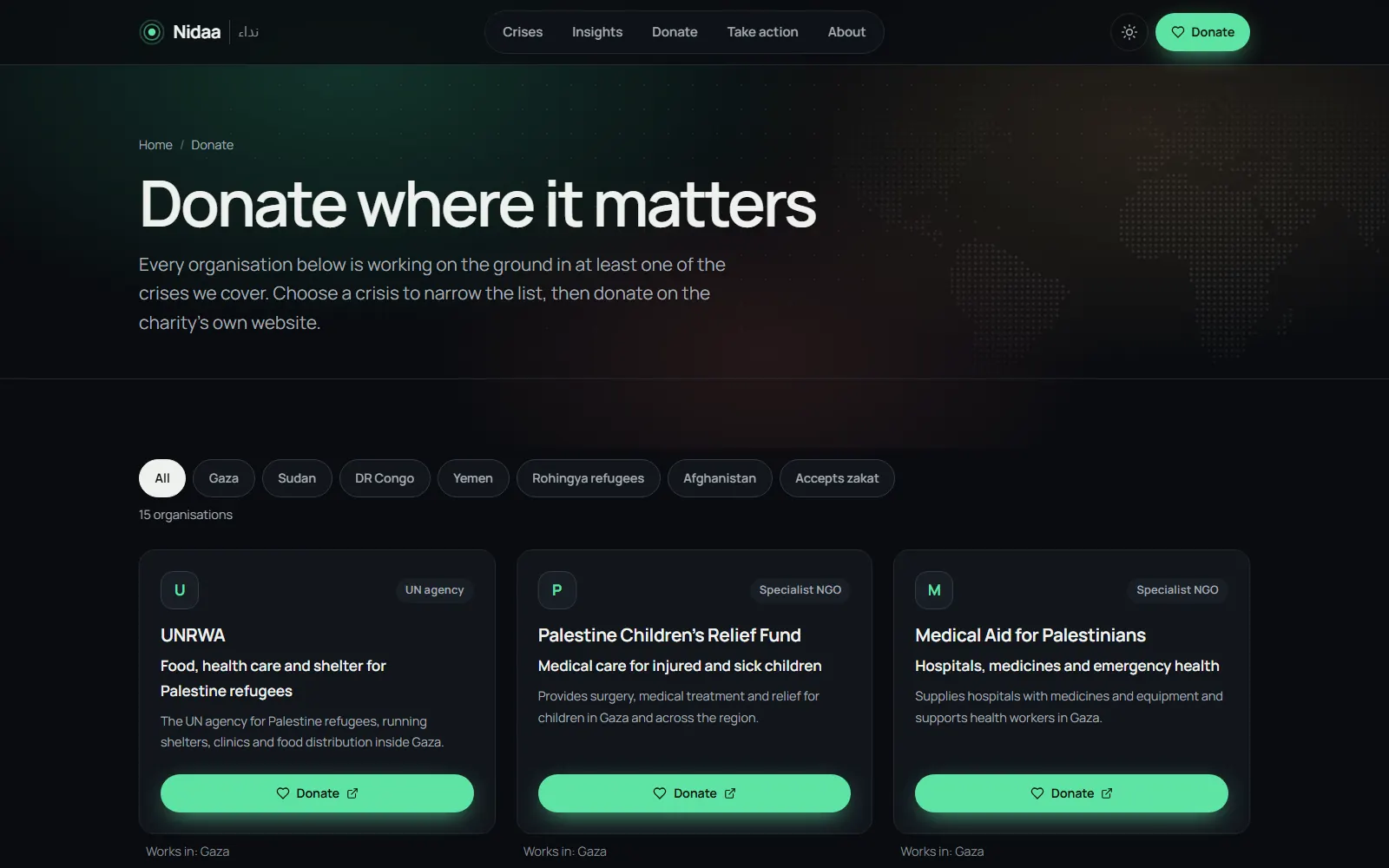
Only UN agencies and registered charities working on the ground, each with a working donate page.
Donors can tell Nidaa they gave and get a personal thank-you email, with their first name on the wall if they choose.
Nidaa never handles money and collects only what visitors type into its forms, with consent.
Tested against WCAG 2.2 AA at three widths and in both themes, with reduced-motion support.
The engineering calls behind the build, and why they were made.
Every page is prerendered HTML on the edge, so the site is fast, cheap to run and has almost nothing to attack.
Forms, filters and the menu work without JavaScript; scripts only add the extras, such as the live donor counter.
Only the forms need a server, so they run as Cloudflare Pages Functions with D1 instead of a separate backend.
Accessibility, CSP, link and layout checks run on every route at three widths, so content updates can’t quietly break a page.
Next project
ZNova project · E-commerce · 2026
A WooCommerce store for a school-uniform maker: parents find their school, build its exact kit by season, class and age, and check out in one basket.
That's the kind we like. Tell us about it and we'll reply with how we'd approach it.
Change theme